
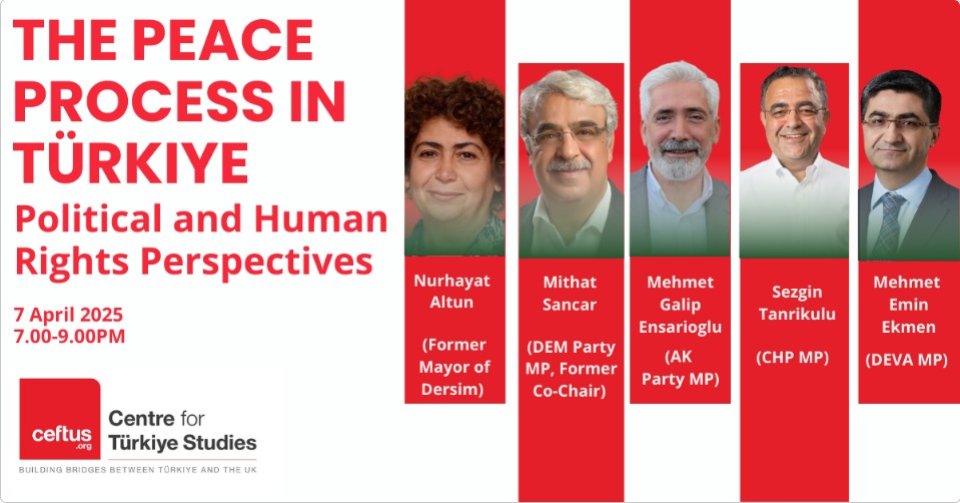
Legal and Political Framework for Conflict Resolution Presentation CEFTUS - 07.04.2025
06.04.2025
Dear Guests and Distinguished Speakers,
Today, you have had and will continue to have the opportunity to listen to significant presentations from experts across two separate sessions. In order to avoid repetition, I will confine my remarks to my designated topic.
Before moving on to ‘Legal and Political Frameworks for Conflict Resolution’, I would like to extend my gratitude to İbrahim Doğuş and the Ceftus team, particularly Mr. Fatih, for bringing this distinguished team together.
Although the topic is indeed extensive, I want to highlight a few key points:
1. As the DEVA party, we believe that it is right to utilise all means of conflict resolution in ending armed struggles. We support the ongoing process as well as the 13 different initiatives Türkiye has implemented on different dates. Our party Leader, Ali Babacan, has made clear statements in this regard. I want to emphasize this issue that the current process exhibits an atypical character that cannot be explained by any international experience from South Africa to the Philippines, Spain to Ireland. Likewise, it has a unique method that is not similar to any of the 13 previous attempts performed by the Turkish State.
2. We declared our immediate support in the early days of the latest initiative following Mr. Bahçeli's call; however, we, like anybody else, lacked the details about it. In fact, our commitment to the principles of conflict resolution led us to believe that such an initiative deserved a chance, even amidst Türkiye’s democratic challenges and increasing authoritarianism. That is because figures like De Klerk or Santos were not leaders in highly democratic systems.
3. We believe that this latest process that we are discussing is more favourable to succeed than previous attempts, due to factors such as Mr. Bahçeli's role in Turkey’s domestic political context and the regional developments. Despite the political operations conducted through the judiciary over the past three months, we continue to support the successful completion of this initiative.
4. While we defend the state’s legitimate right to combat armed organizations, we believe that what is more effective is to eliminate the root causes of political violence through a structuralist approach. We are, however, concerned that while the root causes remain, even when an organisation is dismantled, new ones will emerge in its place.
As we come to our headline, which is about the legal and political framework:
I would like to briefly address the political dimension of the process, which, in one way or another, has been touched upon by each speaker across the two sessions.
The latest initiative in Türkiye is distinct from its predecessors in many respects. First, and perhaps the most significant aspect is that it was brought to the public, in other words, made visible by Mr. Bahçeli, despite that the initiative does not belong to him. Given that Mr. Bahçeli not only embodies a deeply rooted sociological form of nationalism but also holds substantial influence within the security and judicial bureaucracy, it is a crucial aspect to pay attention. I use the term “make visible” because, in my view, there has been a simultaneous process underway since mid-2023 involving İmralı, Kandil, and Syria as well as international partners occasionally participating in it, which was not open to the public at all. With the convergence of the nationalist-statist line represented by Mr. Bahçeli and the Islamist-populist leadership represented by Mr. Erdoğan, we can say that the potential of these two leaders to mobilize popular support in favor of the process is at least 50%.
Another outcome of the way that this initiative is conducted is that the socialisation of the process is carried out in the top-down approach rather than a bottom-up one. In that, social consent is accrued through the trust in political leaders. Today, a citizen from MHP, AK Party, and Dem Party may find it difficult to fully rationalize or emotionally internalize the process, but neither does he/she develop a strong objection that would undermine the position of the leaders. This will probably lead to an interesting experience in the discussions on the socialisation of peace processes.
Another distinctive feature is that, unlike previous initiatives, only one political party within the Grand National Assembly of Türkiye has openly opposed the process, while all other parties offer varying degrees of support. Notably, the main opposition party, CHP (Republican People’s Party), continues its support despite numerous illegitimate (allegedly judicial) operations targeting its elected mayors, municipalities, and affiliates.
I also think that the open and sometimes high-toned and sharp political opposition from the secular-nationalist İYİ Party —under the roof of the Turkish Parliament—is a sign for the healthiness of the current process. It is very important and valuable that those who look at the process with criticism and concern and those who oppose it can see their perspectives represented within the political arena. Therefore, İYİ Party's opposition should be viewed as a necessary component for the proper functioning of the process.
We should also note that the current process, which has gained a degree of public visibility through a rather contrasting figure such as Mr. Bahçeli, has fostered a sense of trust and legitimacy not through President Erdoğan, but rather through Mr. Bahçeli himself. Despite being a political actor who, at one time, took significant steps to shift the republican paradigm concerning the Kurdish issue, Erdoğan has, over the past decade, lost much of his credibility and trust among Kurdish constituencies. In contrast, Bahçeli has surprisingly generated a level of confidence, particularly among Kurds. The fact that it is Erdoğan’s credibility casting a shadow over Bahçeli, rather than the other way around, reveals a rather striking political picture.
Another point to be noted in terms of the political framework is that the Dem Party has successfully carried out the bridging role assigned to it since 1 October, when the process became public. In particular, the visits to political parties have had very important results in terms of gaining support at the institutional level, if not at the grassroots level. The parties visited did not turn the fact that they were not informed by the state or the government into a problem. This signaled a willingness to support given to the process.
The AK Party and President Erdoğan, on the other hand, have deliberately chosen to remain silent about the process. In fact, during the first two months, Erdoğan either did not speak at all or spoke only minimally. Until now, AK Party officials have not taken part in this and similar platforms. If Mr. Ensarioğlu speaks here today, he may be the first AK Party politician to speak at such an event. This is also understandable. The AK Party government previously initiated disarmament-oriented processes in 2004, 2009, and 2013, all of which failed, failures each of which came at significant political cost. Hence, the current choice to communicate the process primarily through Bahçeli and to emphasize the absence of bargaining likely reflects a lesson learned from those past experiences.
My final remark regarding the political framework is this: Since the beginning of this process, the dominant narrative has been that it is a model devoid of negotiations or bargaining. However, I believe that both the state bureaucracy in particular and, ultimately, both parties involved are fully aware of the requirements and responsibilities the process entails. I would argue that these necessities and responsibilities are generally acknowledged explicitly, though at times they are implicitly accepted. In other words, the no-bargaining frame was adopted as a mode of communication. But this emphasis did not eliminate the awareness of the issues and the need for requirements in terms of the outcome.
In terms of the legal framework of the process, it should be noted that in numerous speeches, Mr. Erdoğan and Mr. Bahçeli have emphasized the opportunities for expansion in the political and democratic sphere that would arise from the PKK's self-dissolution. According to one statistic, Bahçeli 17 times and Erdoğan 16 times made direct speeches or press statements, each of which took at least ten pages of space, emphasising democratisation, the expansion of the political arena, and the role of the Grand National Assembly of Türkiye.
Despite the frequent and deliberate emphasis on the Grand National Assembly of Türkiye, nearly six months since October 1, there has been no formal or informal briefing provided to the Assembly by state bureaucrats and ruling political actors. Only the DEM Party and the İmralı Delegation have conducted informational tours, which primarily conveyed intentions rather than substantive content. Let's put it this way, any information that was not available in open sources was not shared during this round of visits. Thus, you can easily say that we are in a very transparent process :)
The humor aside, I think that the limited information sharing is related to that the actors themselves have limited information. In other words, it is not that they know more than they are revealing to us, but rather that the information made available to them at this stage is itself quite limited.
In such a process, the Grand National Assembly of Türkiye may assume various roles. First, it may be tasked with providing a legal framework, certain specific laws, and certain legal assurances for those involved in its implementation. Second, establishing a legal framework for the liquidation of the organisation's cadres, such as the Return to Home Law (a.k.a. reintegration into the society). Third, to make legislative and constitutional reforms to broaden political and democratic spheres by strengthening human rights and freedoms.
To date, no legislative regulation concerning the management of the process has been brought to the agenda. However, the law enacted in 2014 for the previous resolution process, details of which I will provide below, remains in force. Therefore, it may not be necessary to introduce a new legal framework to ensure the legal protection of those involved in the process.
Law on Ending Terrorism and Strengthening Social Integration
Law No: 6551
Date of Adoption: 10 July 2014
Nonetheless, there is a great need for legislation, resembling what might be called a Return to Home Law, that outlines the judicial procedures and legal protections for members who lay down arms in the event the organization disbands, both within and outside Türkiye. The current Turkish Penal Code and the Anti-Terror Law do not contain provisions suitable for managing such a disbandment process. I also know that the state, particularly during the 2013 process, commissioned detailed reports on this matter from experts. I assume that, when the right time comes, this law will be submitted to Parliament.
Even before any comprehensive legal or constitutional reforms are made to expand democratic space, particularly concerning Kurds, various administrative actions could be taken. Examples include, but not limited to, administrative measures that can be taken to advance the removal of administrative obstacles regarding the early release of some convicted PKK members, even if temporarily; releasing ill prisoners and detainees or improving their sentencing conditions; and ending the practice of trustee appointments, thereby reinstating elected officials to their posts. These steps could all be implemented through administrative measures.
Further administrative actions could be taken to promote the public use of the Kurdish language. This includes facilitating Kurdish-language education and cultural activities under a comprehensive program. Many of the obstacles faced by Kurdish cultural events, from venue rejections to outright bans, could be eliminated without the need for new legislation.
Our party's program and policy action plans also include broader and longer-term reforms on this issue. These include lifting the restrictions on mother-tongue education, debate on constitutional citizenship, and strengthening the role of local governments. Undoubtedly, these and other reforms will be on Parliament’s agenda in days to come.
Thank you.